|
|
|
|||||||||
|
|
|
|
|
|
|
|
|
|
|
|
|
|
|
|||||||||









|
|
|
|||||||||
|
|
|
|
|
|
|
|
|
|
|
|
|
|
|
|||||||||
|
The Partnership's Core Faculty Members: |
|
|
|
Aaron Wolf is a professor of Geography in the College of Earth, Ocean, and Atmospheric Sciences at Oregon State University. His research focus is on the interaction between water science and water policy, particularly as related to conflict prevention and resolution. He is author of Hydropolitics Along the Jordan River: The Impact of Scarce Water Resources on the Arab-Israeli Conflict, (United Nations University Press, 1995), and a co-author of Core and Periphery: A Comprehensive Approach to Middle Eastern Water, (Oxford University Press, 1997) and Transboundary Freshwater Dispute Resolution, (United Nations University Press, 2000). Wolf coordinates the Transboundary Freshwater Dispute Database, an electronic compendium of case studies of water conflicts and conflict resolution, international treaties, national compacts, and indigenous methods of water dispute resolution (www.transboundarywaters.orst.edu). He has acted as consultant to the US Department of State, the US Agency for International Development, and the World Bank on various aspects of transboundary water resources and dispute resolution in the Middle East, Central Asia, Southeast Asia, Southern Africa, West Africa, Mexico. He is fluent in Hebrew. |
 |
Lynette de Silva is the Director of the Program in Water Conflict Management and Transformation in the College of Earth, Ocean, and Atmospheric Sciences at Oregon State University. Ms. de Silva coordinates the administration and implementation of three focus area programs: the graduate/professional certificate program; the Transboundary Freshwater Dispute Database, an information technology/outreach program; and the University Partnership for Transboundary Waters, a collaborative research program. This involves contributing to issues of topical scientific and societal importance; adding to state, national, and international visibility; and consolidating programmatic cores and teaching missions. |
 |
Michael Campana is a hydrogeologist and international expert on a range of complex water management issues. He became Director of the Institute for Water and Watersheds in the College of Earth, Ocean, and Atmospheric Sciences at Oregon State University in June 2006 after serving as the director of the Water Resources Program at the University of New Mexico. He has done extensive research on water resources in developing countries, transboundary water resource issues, water allocation and availability, and other areas. He is also founder and president of a charitable foundation that funds and undertakes water, health and sanitation projects in developing nations. Dr. Campana received his doctorate in hydrology from the University of Arizona. |
|
University of California, Riverside (USA) Ariel Dinar is a Professor of Environmental Economics and Policy and the Director of Water Science and Policy Center at the Department of Environmental Sciences, University of California, Riverside, USA. He teaches, conducts research and publishes on water economics, economics of climate change, international water, strategic behavior and the environment, and regional cooperation over natural resources. He is involved in various forums, promoting the teaching of international water in an interdisciplinary way. His recent work on international water was published in Ecological Economics, International Studies Quarterly, International Game Theory Review, Journal of Political Science Education, and International Negotiation. With colleagues from several disciplines he co-authored a text book, its second edition was published recently by World Scientific Publishers (“Bridges over Water”).
|
|
University of British Columbia (Canada) RICHARD KYLE PAISLEY (Canada) is the Director of the Global Transboundary International Waters Initiative and a senior research associate at the Institute of Asian Research as well as an adjunct professor and founding director (2000 to 2007) of the Dr. Andrew R. Thompson Natural Resources Law Program at the UBC Faculty of Law. Richard’s academic background includes degrees in biochemistry, marine resource management, law and international law from UBC, University of Washington, Pepperdine University School of Law and the London School of Economics. His current research, teaching and legal practice interests are in the areas of international water and energy law, international environmental law, negotiations and environmental conflict resolution. He has directed a wide range of conferences, workshops and research projects, published extensively and been an advisor, trainer and special counsel on these subjects to numerous international agencies, governments, non governmental organizations and aboriginal groups including the: FAO, UNDP, IUCN, GEF, WWF, CIDA, DFAIT Canada, CPAWS, TFN, World Bank, UNOPS, Nile Basin Organization, Mekong River Commission Secretariat and the Nepal Water and Energy Commission Secretariat.
|
|
GLEN HEARNS is a senior policy analyst at EcoPlan International and a board member of the Canadian Water Research Society. He has over a decade of experience in facilitation, conflict resolution, resource management and strategic planning. He is involved in managing, training and implementing strategic planning for local economic development related to several projects in Africa, Latin America and Asia as part of EcoPlan's on-going LED project, developed jointly with UN-Habitat. He has also been involved in developing national water resources strategies. He was a member of the Crucible Group: a multi-disciplinary international think tank on genetic resources, and has helped formulate genetic resource policies with the Ticuna Indians in Colombia, and the governments of Lao and Viet Nam. For almost a decade he managed the environmental component of a Track Two diplomatic process to develop confidence building measures for territorial dispute resolution in Southeast Asia. From 2002-04 he worked with Médecins Sans Frontières to help create and implement local health care programs in rural Colombia and the Cong
|
|
Susan Bazilli, is a lawyer, author, educator, social entrepreneur and advocate, who has worked globally on issues of women's rights for more than twenty-five years. A graduate of Osgoode Hall Law School, she lived and worked in South Africa from 1985-1991, and is the editor of the groundbreaking text "Putting Women on the Agenda: Women, Law and the Constitution in Southern Africa". From 1992 - 1997, she was the Legal Director of METRAC, The Metropolitan Committee on Violence Against Women in Toronto, Canada, and founded the Internet-based Ontario Women's Justice Network. In 1997 she became the first Executive Director of the California Alliance Against Domestic Violence. Susan's international missions have included women's human rights training in Bosnia, Lithuania and East Africa for Women Law and Development International; bilateral missions in Azerbaijan, Kyrgyzstan and Uzbekistan for the OSCE; trainings in ICTs for development in the Baltic and Balkan regions for USAID and CIDA; managing the gender program for the American Bar Association - CEELI Program in Russia; developing and coordinating a seven country Southern African Women's Legal Rights program as the CEDPA Legal Specialist, funded by USAID; and providing strategic counsel to the UNDP and the World Bank SPADA program in Indonesia on women’s peacebuilding. She is currently the project manager for the Global Transboundary International Waters Governance Initiative. |
|
University of New Mexico (USA) Denise Fort has an extensive background in environmental and natural resources law - over 30 years of practice, politics, reflecting and writing about policies, all animated by a belief that society must turn toward a more sustainable relationship with its environment. She believes that law plays a critical role in establishing the institutions that govern those relationships. Denise began her career as an environmental attorney with New Mexico Public Interest Research Group and Southwest Research and Information Center, served as special assistant attorney general in the state’s Taxation and Revenue Department, has chaired the Western Water Policy Review Advisory Commission, been active in the National Research Council, was appointed Secretary of the New Mexico Department of Finance and Administration and moved on to head the state Environmental Improvement Division. Denise then turned her focus to teaching, spending a year as a research associate at UNM's Institute of Public Policy and the UNM School of Law. She then served as executive director of Citizens for a Better Environment and as a consultant for the Natural Heritage Institute in California, before returning to New Mexico. In 1991, she became director of the Water Resources Administration Program at UNM and joined the law school faculty at that time. Denise was named Director of the Utton Center in July 2011. |
|
Anthony Turton is a political scientist by formal training, but with a strong foundation in peace-building in areas of high conflict. Much of his work has been on transboundary waters, first in rivers and then into the mining sector and groundwater impacts. His current work is mostly in the mining sector, most notably around the risk of acid mine drainage (AMD) to both surface and groundwater resources in the headwaters of the Limpopo and Orange River basins. His belief is that sub-national transboundary conflicts are often more challenging than international transboundary issues are, which it supported by the current AMD issue in South Africa. He is also a Trustee of the Water Stewardship Council of Southern Africa (http://www.wscsa.org) and a founding member of the South African Water, Energy and Food Forum (SAWEF) (https://twitter.com/SAWEF2013). |
 |
Peter Ashton is employed as a Principal Scientist and Divisional Fellow in the Division of Water, Environment and Forestry Technology in the South African Council for Scientific and Industrial Research (CSIR), and specializes in water quality and water resources management issues. Peter has over 33 years experience in research and environmental consultancy projects in 26 African countries (especially those in southern and central Africa). He has specialist knowledge and expertise in the assessment of water quality problems in Africa and in the design, implementation and evaluation of environmental management programmes. |
|
Inga Jacobs is a transdisciplinary political scientist in the Natural Resources and the Environment (NRE) Operating Unit in the South African Council for Scientific and Industrial Research (CSIR). She specialises in transboundary water governance and institutional development in Africa, looking at cooperative governance in shared river basins in the Southern African region in particular. She is actively involved in the Young Water Professionals network, currently serving as YWP’s Global President 2010-2012 and on the International Water Association’s Board of Directors. She also co-founded the Forum for Young Scholars in Transboundary Water Governance, a collaborative and transdisciplinary exchange initiative for scholars interested in this field, and one which encourages the recognition and mutual respect of multiple perspectives. Inga completed her PhD degree in International Relations at the University of St. Andrews, Scotland. Her doctoral thesis investigated norms and transboundary cooperation in the Orange-Senqu and Nile River basins. She also holds a Master of Arts (MA) cum laude in International Studies from the University of Stellenbosch, and a Bachelor of Arts (BA) in International Relations from Grinnell College in the United States. Specialist areas of interest: Transboundary cooperative water governance and regional environmental security, Sustainable knowledge transfer in the water sector, benefit-sharing and cooperative management strategies in transboundary water governance, water policy in Africa, Gender, principled content of transboundary cooperation – legal frameworks, institutional development, institutional capacity building, integrated land and water management, the water-energy-food security nexus, and evaluating effectiveness of land and water policy reform. |
|
|
|
University of Zimbabwe (Harare, Zimbabwe) Emmanuel Manzungu received his doctoral training in irrigation/water management at Wageningen University (The Netherlands). He started off his research career as a government research officer before joining the Department of Soil Science and Agricultural Engineering at the University of Zimbabwe as a research associate where he is currently based. In 2001 he undertook a research on multi-stakeholder platforms in water resource management in southern Africa. In the same year he received a research grant from the Water Research Fund of Southern Africa (WARFSA) to undertake a research entitled "Sustaining agriculture and livelihoods in the Odzi sub-catchment,". Dr. Manzungu has published widely on irrigation./water resource management in Zimbabwe and has much experience in the formation of Catchment Management Associations in Zimbabwe as well as working with River Basin Organizations such as the Orange River Basin Commission (ORASECOM). His technical specialties are Irrigation management, Catchment Management, and Integrated Water Resources Management. |
Pinimidzai Sithole has a broad sociology and social anthropology education background and over 3 years professional experience in project planning, appraisal and rural development. His areas of expertise in sociology and social anthropology include gender education, community training, natural resources management and governance, implementation and appraisal of HIV and AIDS policies, and rural development projects throughout Zimbabwe. He has attained a high profile in organizational development and the facilitation of common vision workshops for rural communities. In addition, Mr. Sithole is an expert in the design of logical frameworks, entrepreneurial skills development, change management, stakeholder analysis and consultation, project planning and team building using Problem Tree Analysis and other facilitation tools. Since 2000, Mr. Sithole has devoted energy in facilitating water policy reform processes, analysing the functions of Catchment and Subcatchment Councils and determining the core business of government institutions and other stakeholders in the natural resources management under liberalised and decentralised economies. Mr. Sithole is as Research Fellow/Project Coordinator by the Centre for Applied Social Sciences Trust (CASS Trust) where he Co-ordinate fieldwork activities and facilitates and implement participatory rural development initiatives in water resources management at the community level. He is also an Associate Consultant for Business Associates P/L. He is fluent in English and Shona, in reading, writing and speaking. |
|
|
Chinhoyi University of Technology (Chinhoyi, Zimbabwe) Innocent Nhapi is an expert in sanitary and environmental engineering with experience in project implementation, education and development. His experience includes working for a municipal council in Zimbabwe, for the University of Zimbabwe, the National Community Water and Sanitation Training Institute (NCWSTI) in South Africa and the WaterNet Project (regional capacity building project in Southern Africa). From October 2005 to October 2008, he was with the UNESCO-IHE Institute for Water Education as a Project Manager on an NPT-funded Water Resources and Environmental Management (WREM) project at the National University of Rwanda where he was involved in staff development and setting up MSc. and research programmes in Water Resources Engineering and Management. From 2009 to February 2013 he was with the Department of Civil Engineering, University of Zimbabwe as a SADC-WaterNet Professorial Chair in IWRM. In January 2014 he joined the Chinhoyi University of Technology in Zimbabwe. He has experience and research interests in integrated water resources management, catchment environmental planning, pollution prevention strategies, pollution modelling, and urban water systems management. He does consultancy work for the World Bank, UNICEF, UNESCO, GWP and others, on urban water supply, sanitation and environmental planning and management. |
|
Jennifer McKay is a Professor of Business Law and Director of the CCWPL, a university-supported research centre within the School of Business at the University of South Australia. Prof McKay has carved out a niche for CCWPL and its two post doctoral fellows in advice on water policy and business structures. She is the leader of the Specialist Group in International Governance and Regulation for the International Water Association (IWA) and the Water Management Law and Policy Specialist Network for the Australian Water Association (AWA) and has been elected to the Strategic Council of the IWA. Recently the Centre ran its 2nd Annual Workshop in Regulation of Groundwater: Interception by Forestry with three international speakers from South Africa and delegates from the National Water Commission (NWC) as well as members from the federal government. The event was attended by leading national and international water experts, in the field of water management and by policy makers from Canberra. Her research leadership has led to several ARC funded projects, leadership in two CRCs, and work for the World Bank. She has led two projects in India and South Asia for the Australian Centre for International Agricultural Research (ACIAR) and for the International Water Management Institute (IWMI). She has also conducted water policy and law research in the US at the University of California Berkeley, under a Fulbright senior fellowship and had a visiting appointment at Oxford University Centre for Socio Legal Studies. She has over 100 publications. She is on the editorial board for the Australian Journal of Emergency Management (for the Attorney General’s Department in Canberra) and also of several national and local journals. She and the team at CCWPL have been invited to give policy advice at national and local levels, for example through service on the Natural Resources Management Council SA and also as Part time Commissioner in the Environment Resources and Development Court since its inception. She has been recently reappointed for another 3 years.
|
|
|
Jan Lundqvist is a professor of Geography at the Department of Water and Environmental Studies (DWES), Linkoping university, Sweden, since 1980. His research orientation and expertise are related to various issues converging around land and water resources management, including; the role of water in livelihood from the household to international level; food/nutritional and environmental security; competition for water between urban and rural sectors and between upstream and downstream areas; water productivity; and challenges related to transboundary water utilisation. He has been responsible for research projects on these issues around the world, including Tanzania, Kenya, Malawi, The Sudan, Egypt, Middle East, Southern Africa, Sri Lanka, India, Brazil, Norway and Sweden. Current research projects in India and Southern Africa. Dr. Lundqvist also holds a part time assignment at Stockholm International Water Institute (SIWI). |
|
|
University of Dundee (United Kingdom) Patricia Wouters is the Director of the Dundee IHP-HELP Centre. Professor Wouters leads an inter/multi-disciplinary team of water law, policy and science experts at the University of Dundee, Scotland. Professor Wouters established the graduate water law programme at Dundee in 1996 and has worked since then to build the capacity and range of expertise in the unit to its current research team comprised of experts in three areas of water law (international water law; national water law; and regulation of water services) and three areas of water science (river catchment hydrology; sustainable flooding; and climate change). The Dundee IHP-HELP Centre for Water Law, Policy and Science is the first Centre under the auspices of UNESCO in the UK and the first of its kind in the world. Pat serves on the International Advisory Committee for the United Nations University Institute of Water Environment and Health (UNU-INWEH); is a member of the Global Water Partnership Technical Experts Committee (GWP-TEC); a member of the World Economic Forum Global Agenda Council on Water Security (WEF-GAC); a member of the SUEZ Foresight Advisory Committee; co-chair of the Legal Experts Group of the World Water Assessment Programme responsible for the World Water Development Report (UN-WWAP). Professor Wouters has provided expert advice on national and global water security issues to the UK government and has been involved in high-level diplomatic meetings on regional water security (the Abu-Dhabi talks; Beirut talks) and continues to advise national governments and public policy bodies on transboundary water security issues. |
|
Sergei Vinogradov (LL.B., Ph.D. Moscow) is a Senior Lecturer at CEPMLP and Director of our LL.M. programme. He joined the Centre as a Senior Research Fellow in April 1996. Before joining the Centre, between 1994 and 1996, he was a visiting scholar at the Max Planck Institute for Comparative Public Law and International Law in Heidelberg (Germany). Prior to that he worked as a Senior Research Fellow at the Institute of State and Law of the USSR (Russian) Academy of Sciences. He also taught international law at the Faculty of Law of the Moscow State University. His main field of expertise includes international environmental law, international law of natural resources, law of the sea, as well as environmental and natural resource law of Russia and the CIS. He is a member of the Water Resources Committee of the International Law Association and of the Commission on Environmental Law of the IUCN/World Conservation Union. At the Centre Dr. Vinogradov teaches courses in international environmental law, international law of natural resources, environmental law and policy for natural resources and energy, and international nuclear law. |
|
Alistair Rieu-Clarke is a Senior Lecturer in International Law and heads up the International Water Law Research Cluster at the Dundee IHP-HELP Centre. Alistair’s research interests centre around assessing the effectiveness of transboundary watercourse treaty regimes.
|
|
Asia Yunnan University (China) Daming He is the Director of the Asian International Rivers Center, deputy director of School of Life Science at Yunnan University in Kunming, China. His multi-disciplinary research and teaching background includes hydrology and transboundary water resources management, physical geography and environmental security. Since 1996, his focuses has been on utilization, allocation, and management of water resources, ecosystem change environmental security in international rivers. In 2003, he was awarded leading scientist in ecology and biodiversity conservation, from his work on transboundary ecological security in international river basins in China. His technical specialties include, Physical Geography, Hydrology, Ecology, GIS for natural resources and environments and Regional Sustainable Development. He has worked extensively in the upper basin portions of major Asian international basins including the Mekong, Salween, and Red rivers. |
|
Asian Institute of Technology (Thailand) Ashim Das Gupta is Professor in Water Engineering and Management (WEM) Field of Study of School of Civil Engineering at the Asian Institute of Technology, Bangkok where he has been serving since 1976. He is involved in teaching and research in water resources development and management, in particular on topics related to integrated water resources management, groundwater resources evaluation, modeling and management of water resources systems and environmental impact assessment of water resources projects. Some of the recently completed research work related to various themes of IWRM can be cited as "Integrated Water Resources Management in a Water Abundance-Scarcity Cycle Regime, A Case Study of Bangladesh", "Urban Water Demand Management in Bangkok, Thailand", and "Institutional Analysis of Management Models in Community Irrigation Systems: Northern Vietnam." In addition to teaching and research, he has been actively involved in different sponsored research projects dealing with hydrology and water resources. Some of the significant contributions in the area of sponsored projects can be cited as "Development of a Water Resources Information System for Thailand", "Development and Management Studies of Groundwater Resources in the Bangkok Area", "Study of Potential Development of Water Resources in the Salawin River Basin", "An Integrated Decision Support System for Groundwater Monitoring and Management", and "Crop Modeling with GIS and Genetic Algorithm". Currently he is a Human Resource Development consultant under a Danida assisted capacity building project at the Water Resources University, Hanoi, Vietnam. |
|
University of Haifa (Israel) Ambassador (Ret) Aviram is a lecturer at Haifa University on cross boundary water interactions. His experience is based on 25 years of multilateral and bilateral diplomacy, while serving in high ranking positions at the Israeli Ministry of Foreign Affairs including Chief of Staff of H.E. Shimon Peres. His career at the Ministry was highly connected to hydro politics and water related issues. His responsibilities included: Head of Israel’s negotiating team on water issues within the framework of the multi-lateral peace process - the group initiated and established significant regional water related projects such as the Middle East Desalination Research Center in Muscat, Oman. Water and Environment Department was established by Ambassador Aviram and served at the time as a leading body for overall external relation of Israel in the water sector. Within this framework he participated in the bi-lateral negotiations with Arab neighboring countries. He established BIT –Consultancy, a multidisciplinary consulting agency specializes in providing services for cross-boundary-water-interactions projects which demand hydro-political expertise. BIT gave services among others to multinational companies in the context of the Red Sea- Dead Sea Water Project , it is the geo-political consultant to the Rehabilitation of the lower Jordan River project and NGOs in developing strategy for cross border water cooperation. He is contributing to publications in the context of cross-boundary water interactions for example "The Economic Dimension of the Arab Peace Initiative: Water Cooperation" and " The International Hydro-Political Policies of Israel". |
 |
Dr. David Katz is a lecturer in the Department of Geography and Environmental Studies at University of Haifa in Israel, where he teaches classes in political and economic geography and in environmental and resource policy and economics. He specializes in water resource management and has published several articles dealing with transboundary water policy. Prior to University of Haifa, David was the Professional Director of the Akirov Institute for Business and the Environment at Tel Aviv University, where he also taught in the School of Business Management and the School of Environmental Studies. He holds a Ph.D. in Natural Resource Policy from the University of Michigan. In addition to his academic positions, David has also conducted a number of research projects for government agencies and NGOs, including several studies specifically addressing transboundary water management in the Middle East. |
 |
Deborah Shmueli is an associate professor in the Department of Geography and Environmental Studies at the University of Haifa. A strong focus of her efforts is towards environmental and public sector conflict management and community and institutional capacity building. In the water arena she has published articles on issues related to institutional frameworks and negotiations, publications (both singly and co-authored) include: Institutional Frameworks for Management of Transnational Water Resources; Negotiating Middle East Water Management; Real and Ideal Institutional Frameworks for Managing the Common Arab-Israeli Water Resources; Approaches to Water Dispute Resolution: Applications to Arab-Israeli Negotiations; Application of International Law of Water Quality to Recent Middle East Water Agreements; Water Quality in International River Basins; and The International Hydro-political Policies of Israel. She is co-established and is on the steering committee of the Graduate Program in Water Studies. She received her Ph.D. in Architecture and Urban Planning (1992) at the Technion, Israel Institute of Technology, and her M.C.P. and B.S. from the MIT (1980). |
|
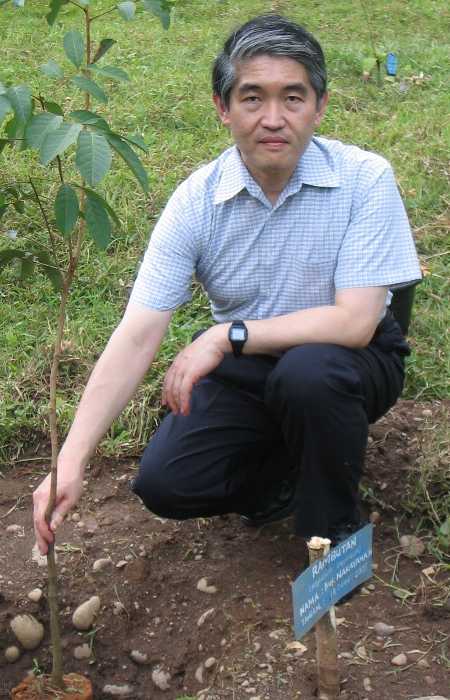
Mikiyasu Nakayama is a Professor of the Graduate School of Environmental Studies, Graduate School of Frontier Science, the University of Tokyo, Japan. His research activities on transboundary waters focus on Involvement of international organizations in management of transboundary waters. He received his Ph.D. from the University of Tokyo . He served as a programme officer in the United Nations Environment Programme (UNEP) between 1986 and 1989. From 1989 to 1999, he used to teach water resources management and its international and environmental aspects at the Utsunomiya University . He has been also serving as an advisor and an expert for several United Nations Organizations (UNEP, UNCHS, UNCRD, and UNU), as well as for Non-Governmental Organizations such as IUCN and ILEC. From 1994 to 1996, he was "on loan" to the North African Department of the World Bank to deal with water resources management projects in Morocco, Tunisia and Iran. From 1999 to 2004 he served as professor at the Tokyo University of Agriculture and Technology, as well as Vice Dean of the United Graduate School of Agricultural Sciences. Currently he serves as advisor of a number of domestic and international organisations, including the United Nations University where he is appointed as Academic Advisor to its Environment and Sustainable Development Programme since 2002. |
| University of Haifa | |
|
Universidad Nacional (Costa Rica) Alexander López Ramirez is the director of the Mesoamerican Center for Sustainable Development of the Dry Tropics (CEMEDE), and a lecturer for the International Center for Political Economy at the Universidad Nacional de Costa Rica. He has conducted extensive field work in the Brazilian Amazon and in Central America in issues related to socio-environmental conflict resolution and the management of transboundary river basins. Currently he is member of the scientific steering comitee of the Global Environmental change and security project (http://www.gechs.org/), and co-director of the initiative: Environment, Development and Sustainable Peace. Bridging the gap between north and south (http://www.sustainable-peace.org/). |
Universidad Nacional de El Litoral (Argentina) Ofelia Clara Tujchneider is the Director of the Geohydrological Research Group (GIG) at the Faculty of Engineering and Hydrological Sciences, Hydrology Department at National University of El Litoral in Argentina. She is also a researcher of the National Council of Scientific and Technical Research and a member of the Scientific Board of the Geociences Programme at UNESCO, and is the Chairperson of the Working Group 5 in Hydrogeology for 2004-2007. She has been a professor in Groundwater Resources Management at the Faculty of Engineering and Hydrological Sciences since 1973, specializing in environmental and hydrogeological Projects, including transboundary water resources such as the Gurani Aquifer, an international water body. |